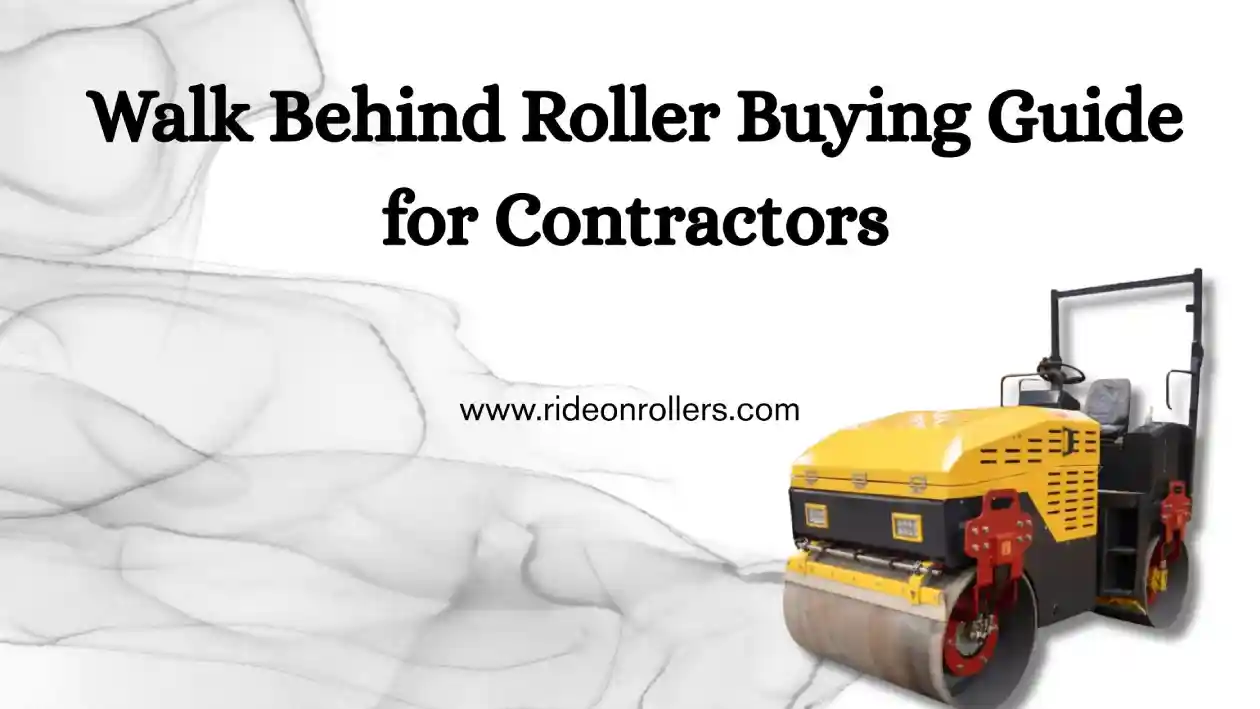
Choosing construction equipment is an important decision for contractors. The right machine can make site work more convenient and productive, while an unsuitable machine can create operational difficulties, unnecessary maintenance, and delays.
Walk behind rollers are particularly useful for contractors working on smaller roads, asphalt repairs, pathways, utility reinstatement, parking areas, landscaping projects, and other sites where larger rollers may not be practical.
However, choosing a walk behind roller should involve more than comparing prices.
Contractors need to consider the type of material being compacted, project size, available working space, drum configuration, machine weight, engine, vibration system, maintenance requirements, and manufacturer support.
Shree Shakti Infratech’s current range includes single-drum and double-drum walk behind rollers, with models listed for soil and asphalt applications.
This guide explains the main factors contractors should evaluate before purchasing.
What Is a Walk Behind Roller?
A walk behind roller is a compact compaction machine controlled by an operator walking behind the equipment.
Depending on the model, it may have a single drum or two drums and can incorporate a vibratory system for compaction.
Its compact format makes it useful where contractors need a roller that can operate in relatively restricted areas.
Walk behind rollers are commonly considered for:
- Asphalt repair work
- Small road projects
- Footpaths
- Parking areas
- Driveways
- Utility reinstatement
- Soil preparation
- Landscaping
- Residential construction
- Confined construction sites
The correct machine depends on the specific application and site conditions.
1. Start With the Type of Work
The first question contractors should ask is simple:
What type of work will the roller perform most often?
A machine used primarily for asphalt work may have different requirements from one used for soil compaction.
Before purchasing, identify whether the equipment will mainly be used for:
- Asphalt
- Soil
- Granular material
- Road base
- Utility trench reinstatement
- Pathways
- Parking areas
- General site preparation
This helps narrow down the appropriate machine configuration.
A recent industry buying guide similarly recommends considering soil type, lift thickness, site access, and the required compaction standard before choosing a roller.
2. Choose Between Single Drum and Double Drum
One of the most important decisions is whether to purchase a single-drum or double-drum walk behind roller.
Single Drum Walk Behind Roller
A single-drum configuration can be useful when contractors need a compact machine for smaller or more restricted areas.
Shree Shakti Infratech lists a single-drum vibratory model with a 425 × 600 mm drum specification, 6.5 HP engine, and maximum working speed of up to 3 km/h.
This type of machine can be considered where manoeuvrability and compact dimensions are important.
Double Drum Walk Behind Roller
A double-drum machine provides a drum at both the front and rear.
Shree Shakti Infratech lists a VR6500 double-drum walk behind roller with 700 kg operating weight, 650 mm drum width, 9 HP engine, and application suitability for soil and asphalt.
The company’s product range also includes a 600 mm double-drum model with a 10 HP engine.
The choice should depend on the surface, project requirements, available space, and expected workload.
3. Consider the Working Width
Working width determines how much surface the roller can cover during each pass.
A wider drum can help cover larger areas more efficiently, while a narrower drum may be easier to use in restricted spaces.
Contractors should consider the actual dimensions of their work areas.
For example, narrow utility routes and small repair sections may benefit from a compact working width, while larger parking or road sections may justify a wider drum.
Do not select the widest machine simply because it appears more productive. The machine must be able to operate comfortably within the site’s available space.
4. Check Operating Weight
Machine weight is another important factor.
A heavier roller can provide greater loading on the surface, but the appropriate operating weight depends on the material and application.
Contractors should consider:
- Soil condition
- Asphalt thickness
- Surface type
- Required compaction
- Site accessibility
- Transport requirements
The operating weight should be matched to the project rather than selected solely on the basis that a heavier machine is always better.
An oversized machine can be inconvenient on small or sensitive work areas, while an undersized machine may require additional passes or fail to achieve the required result.
5. Look at the Vibration System
For vibratory rollers, the vibration system is a major part of the machine’s performance.
Contractors should ask about the machine’s vibration characteristics and whether they are appropriate for the material and intended application.
The objective is to achieve the required compaction without using a machine that is unnecessarily aggressive for the surface.
Project specifications should always take priority when determining the required compaction equipment and operating procedure.
6. Consider Engine Type and Power
Engine selection can influence machine performance, operating convenience, maintenance, and fuel requirements.
Walk behind rollers can be available with petrol or diesel engines depending on the model.
Shree Shakti Infratech’s published range includes petrol-powered single-drum models as well as diesel-powered double-drum models.
Contractors should consider:
- Engine power
- Fuel type
- Local service availability
- Fuel accessibility
- Expected operating hours
- Starting system
- Maintenance requirements
Engine power should be considered alongside the machine’s overall design rather than treated as the only indicator of performance.
7. Consider Site Access
Site access is particularly important when buying a walk behind roller.
Measure the areas through which the machine will need to pass.
Consider:
- Road width
- Gate openings
- Building entrances
- Utility corridors
- Turning space
- Existing structures
- Storage areas
A roller that performs well but cannot reach the working area is not a practical investment.
For urban contractors, compact dimensions and manoeuvrability can be especially valuable.
8. Match the Machine to the Project Size
Walk behind rollers are generally most useful when the project requires compact compaction equipment.
They can be suitable for:
- Small asphalt repairs
- Residential roads
- Footpaths
- Parking areas
- Utility work
- Small commercial projects
- Confined construction areas
For large highways or extensive paving operations, a larger ride-on roller may be more appropriate.
Contractors should therefore assess the average size of their projects rather than choosing equipment based on one exceptional job
9. Consider Asphalt and Soil Requirements Separately
Asphalt and soil behave differently during compaction.
A roller used for asphalt work may need different characteristics from equipment used primarily for soil or granular base preparation.
Shree Shakti Infratech specifically lists one of its double-drum walk behind rollers for both soil and asphalt applications.
Before buying, contractors should explain the materials they commonly work with and the type of compaction required.
This allows the supplier to recommend an appropriate configuration.
10. Check Transportation Requirements
Contractors frequently move equipment between projects.
A walk behind roller should therefore be practical to transport using the vehicles and trailers already available to the business.
Consider:
- Machine weight
- Overall dimensions
- Loading method
- Tie-down arrangements
- Transport frequency
- Storage requirements
A compact machine can be particularly useful for contractors who regularly move between multiple small projects.
11. Evaluate Maintenance Requirements
Construction equipment operates in demanding conditions.
Dust, mud, asphalt residue, vibration, and long operating hours can all affect machinery.
Before purchasing, ask about:
- Engine servicing
- Lubrication
- Air-filter maintenance
- Drum inspection
- Vibration-system maintenance
- Hydraulic maintenance where applicable
- Battery care
- Spare parts
A machine that is straightforward to inspect and maintain can be more practical for contractors over the long term.
12. Check Spare Parts Availability
Spare-parts availability should not be overlooked.
If a machine develops a problem during an active project, waiting for a difficult-to-source component can result in unnecessary downtime.
Ask the supplier about the availability of commonly required components such as:
- Filters
- Belts
- Bearings
- Seals
- Engine components
- Electrical parts
- Vibration-system components
For contractors with several machines, dependable spare-parts support becomes even more important.
13. Consider Manufacturer and Supplier Support
The supplier’s role does not end with delivery.
A good construction equipment supplier should be able to provide product information, operating guidance, maintenance recommendations, and after-sales support.
Contractors should consider:
- Manufacturer experience
- Product range
- Technical support
- Service availability
- Spare-parts support
- Warranty
- Response time
- Long-term product availability
This can make a significant difference when the equipment is used regularly across multiple projects.
14. Don’t Choose Only on Price
Price is important when purchasing construction equipment, but it should not be the only deciding factor.
A cheaper machine may not necessarily provide better value if it has higher maintenance requirements, limited spare-parts availability, or inadequate support.
Instead, contractors should compare the complete ownership proposition.
Consider:
- Purchase cost
- Maintenance
- Fuel requirements
- Spare parts
- Expected working life
- Downtime risk
- Service support
A machine that costs slightly more initially may provide better overall value if it is more suitable for the contractor’s regular work.
15. Check the Machine Before Buying
If possible, contractors should inspect the machine before finalizing the purchase.
Pay attention to:
- Build quality
- Drum construction
- Controls
- Handle design
- Engine installation
- Fasteners
- Guards
- Service access
- Overall finish
If a demonstration is available, observe how the machine starts, moves, turns, vibrates, and responds to operator controls.
This can provide useful information that is not always visible in a specification sheet.
16. Ask About Warranty and Service
Warranty terms should be understood before purchase.
Ask:
- What components are covered?
- How long is the warranty?
- Where is service available?
- Who handles warranty repairs?
- Are replacement parts readily available?
- What happens if the machine develops a problem during a project?
Clear answers can help contractors plan equipment ownership with greater confidence.
17. Think About Your Future Projects
A machine should ideally serve more than one project.
Before purchasing, consider the types of work the contractor expects to handle over the next few years.
For example, if the business regularly undertakes:
- Municipal road repairs
- Asphalt maintenance
- Residential developments
- Utility reinstatement
- Small commercial projects
a versatile walk behind roller may be more valuable than equipment designed for a single specialized application.
Why Choose Shree Shakti Infratech?
Shree Shakti Infratech is a New Delhi-based manufacturer of construction equipment. Its published product range includes walk behind rollers, double-drum rollers, ride-on rollers, vibratory earth compactors, plate compactors, tamping rammers, concrete mixers, and other construction machinery.
Its walk behind roller range includes single-drum and double-drum models with different operating specifications. The company’s published models include machines intended for soil and asphalt applications.
For contractors, the best approach is to share complete project information with the manufacturer or supplier before selecting a model. Details such as the material being compacted, site dimensions, expected workload, access conditions, and preferred engine configuration can help identify a more suitable machine.
Conclusion
Buying a walk behind roller is an investment that should be based on the contractor’s actual working requirements, rather than price or machine size alone.
The right machine should match the material being compacted, project size, working width, operating weight, vibration requirements, site access, engine configuration, transportation arrangements, and expected workload.
Contractors should also evaluate maintenance requirements, spare-parts availability, warranty, technical assistance, and after-sales support before making a final decision.
For small asphalt jobs, road repairs, utility projects, pathways, parking areas, and confined construction sites, a well-selected walk behind roller can provide a practical combination of compact size, manoeuvrability, and compaction capability.
Working with an experienced Walk Behind Roller Manufacturer can make the purchasing process easier by helping contractors select equipment that fits their projects today while remaining useful for future construction requirements.
Shree Shakti Infratech’s range of single-drum and double-drum walk behind rollers gives contractors different configurations to consider based on their application and site requirements.