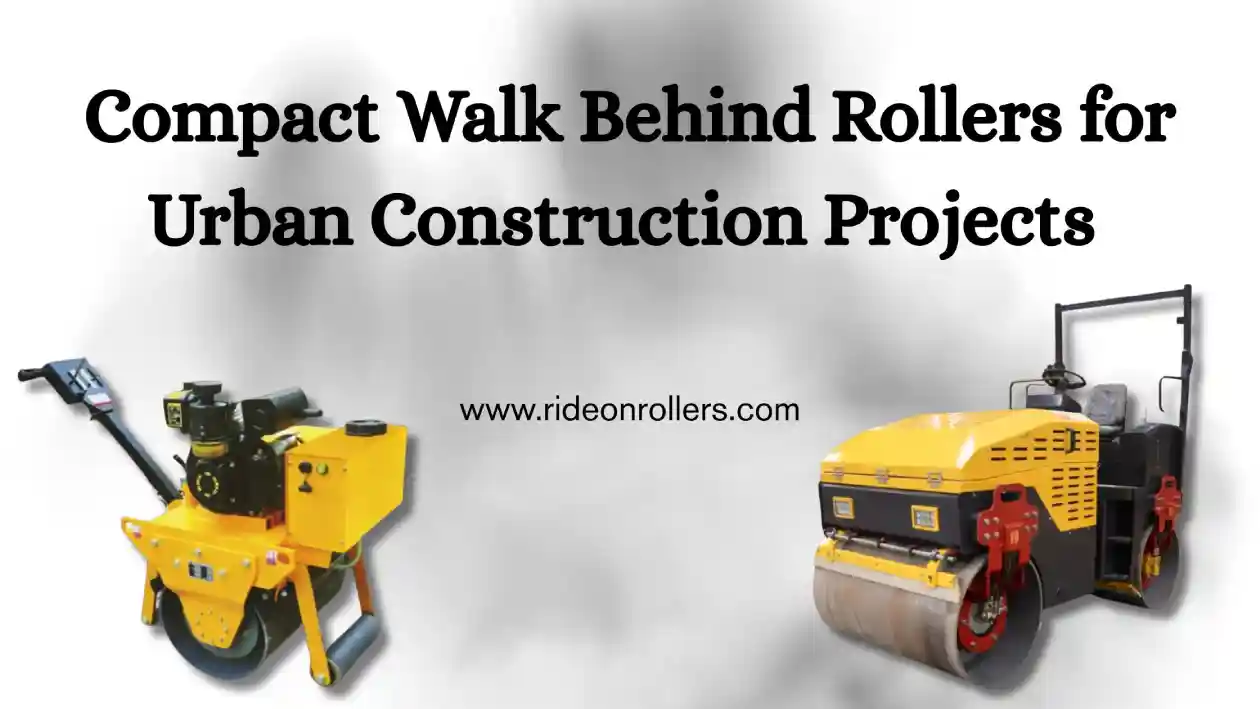
Urban construction projects often present challenges that are less common on large open construction sites.
Roads may be narrow, buildings may be close to the work area, traffic and pedestrians may restrict access, and existing infrastructure can limit the space available for construction equipment.
These conditions make equipment selection particularly important.
A large road roller may be highly effective on an extensive highway project, but it may not always be practical for a small road repair, utility reinstatement project, pathway, parking area, or construction site located within a busy urban environment.
This is where compact walk behind rollers can provide a practical solution.
Designed to operate in relatively restricted areas, walk behind rollers allow operators to carry out compaction work while maintaining better manoeuvrability and access than larger equipment.
Shree Shakti Infratech offers walk behind single-drum and double-drum roller models for construction and compaction applications. Its published range includes compact models intended for soil and asphalt-related work.
What Is a Compact Walk Behind Roller?
A walk behind roller is a compact compaction machine controlled by an operator walking behind it.
Depending on the model, the machine can use single-drum or double-drum configurations and may include a vibratory system for compaction.
Its compact design makes it suitable for applications where access is restricted or where a larger ride-on roller would be difficult to manoeuvre.
For example, Shree Shakti Infratech lists a single-drum walk behind roller with a compact drum arrangement and a double-drum model with a 600 mm drum width.
The exact machine should be selected according to the application, material, working area, and project requirements.
Why Urban Construction Requires Compact Equipment
Urban projects often have limited working space.
A construction team may need to work between:
- Buildings
- Boundary walls
- Curbs
- Utility structures
- Drainage systems
- Existing roads
- Footpaths
- Street furniture
- Landscaping
- Vehicles and other site restrictions
These conditions can make large construction equipment difficult to position and operate.
Compact rollers can provide greater flexibility in such environments because they require less working space and can be easier to reposition.
1. Useful for Narrow Road Repairs
Road maintenance is a common urban construction requirement.
A contractor may need to repair only a section of an existing road rather than compact an entire roadway.
A compact walk behind roller can be useful for these localized repair areas because it can work within smaller sections without requiring the operating space of a larger roller.
This can make it suitable for patching and maintenance work where access is restricted.
2. Suitable for Utility Reinstatement
Urban utility projects frequently involve excavation for water pipelines, drainage, electrical cables, telecommunications, and other infrastructure.
After installation, the excavated area needs to be properly reinstated.
The working area can be relatively narrow, particularly when the excavation is located along an existing road or near buildings.
A compact roller can provide a practical option for compaction within these restricted work zones.
3. Better Manoeuvrability in Confined Areas
Manoeuvrability is one of the main reasons contractors consider walk behind rollers for urban work.
Operators can guide the machine through smaller work areas and around obstacles that may be difficult for larger equipment.
This can be particularly useful when working close to existing structures.
The objective is not simply to use the smallest possible machine, but to select equipment that provides sufficient compaction while remaining practical for the available space.
4. Useful for Footpaths and Walkways
Urban development projects often involve footpaths, pedestrian routes, cycle paths, landscaping areas, and other narrow surfaces.
These areas may not have enough room for conventional road rollers.
Compact walk behind rollers can provide access to these locations while supporting the compaction requirements of the project.
They can be useful during new construction as well as repair and maintenance work.
5. Suitable for Small Asphalt Projects
Urban contractors frequently handle asphalt work on a relatively small scale.
Examples include:
- Road patches
- Parking areas
- Driveways
- Service roads
- Footpaths
- Local road repairs
- Small commercial developments
A compact roller can be easier to transport and position for these applications.
The equipment can therefore complement larger rollers on projects where different areas require different types of compaction equipment.
6. Helpful Around Existing Infrastructure
Urban construction rarely takes place on a completely open site.
Existing infrastructure often remains operational around the construction area.
Contractors may need to work near:
- Buildings
- Drainage channels
- Utility covers
- Poles
- Kerbs
- Retaining structures
- Existing pavement
A compact walk behind roller can provide greater flexibility when the available operating area is limited.
Operators should still maintain appropriate clearance and follow site-specific safety procedures.
7. Practical for Parking Areas
Parking areas can involve relatively tight spaces, especially during renovation or resurfacing work.
A compact roller can be useful for compacting asphalt or prepared surfaces in sections where a larger machine may have difficulty turning or positioning.
This makes walk behind rollers suitable for certain commercial, residential, institutional, and municipal parking projects.
8. Useful for Residential Construction
Urban housing projects can also benefit from compact construction equipment.
Walk behind rollers may be used for:
- Internal roads
- Driveways
- Parking areas
- Pathways
- Landscaping
- Foundation-related preparation
- Small access routes
The machine’s compact format can make it easier to work within developing residential areas where space becomes increasingly restricted as construction progresses.
9. Easier Movement Between Smaller Work Areas
Urban contractors may need to move equipment between several small sections of a project.
For example, a municipal contractor could work on multiple road repair locations rather than one continuous construction zone.
A compact walk behind roller can be practical in such situations because its smaller format can simplify movement and deployment.
This can help contractors match equipment to the scale of individual work areas.
10. Single-Drum and Double-Drum Options
Walk behind rollers are available in different configurations.
Single-Drum Walk Behind Rollers
Single-drum machines can be suitable for applications where compact size and manoeuvrability are important.
Shree Shakti Infratech lists a single-drum vibratory walk behind roller with a 425 × 600 mm drum specification and a stated working speed of up to 3 km/h.
Double-Drum Walk Behind Rollers
Double-drum models provide a different configuration that can be useful for particular soil and asphalt compaction requirements.
Shree Shakti Infratech lists a double-drum walk behind model with a 600 mm drum width, 10 HP engine, and a stated working speed of 0–4 km/h.
The appropriate configuration should depend on the material, surface, project requirements, and operating conditions.
11. Useful for Municipal Construction
Municipal construction involves many projects where compact equipment is valuable.
Examples include:
- Local road repairs
- Footpath construction
- Drainage work
- Utility reinstatement
- Parking improvements
- Public-space development
- Small pavement projects
These projects often take place in areas where traffic, buildings, pedestrians, and existing infrastructure limit the available workspace.
A compact roller can therefore be a useful part of a municipal contractor’s equipment fleet.
12. Can Complement Larger Rollers
Compact walk behind rollers should not necessarily be viewed as a replacement for larger road rollers.
Large rollers remain appropriate for extensive road construction and major paving operations.
Instead, compact rollers can complement larger machines.
For example, a contractor may use a ride-on roller for the main road surface and a walk behind roller for smaller sections, edges, repairs, or areas where access is restricted.
This approach allows equipment to be matched to different parts of the same project.
What Should Contractors Check Before Buying?
Before purchasing a compact walk behind roller, contractors should consider more than the machine’s overall dimensions.
Important factors include:
Drum Configuration
Determine whether a single-drum or double-drum design is better suited to the intended application.
Working Width
A narrower drum can be useful for restricted spaces, while a wider drum may improve productivity on larger surfaces.
Operating Weight
The machine’s weight should be appropriate for the intended compaction work and transport arrangements.
Vibration System
For vibratory applications, check the machine’s vibration characteristics and ensure they are suitable for the material and project requirements.
Engine and Drive
Consider engine type, operating characteristics, drive system, and expected daily usage.
Maintenance
Check access to service points, replacement parts, and routine maintenance requirements.
Manufacturer Support
Technical assistance, servicing, spare parts, and product support can be important for contractors using equipment regularly.
Why Machine Size Should Match the Project
Choosing the largest machine available is not always the best approach.
In an urban environment, a machine that is too large can create practical problems.
It may require more operating space, be difficult to transport into restricted areas, and have limited manoeuvrability around existing infrastructure.
At the same time, selecting a machine that is too small for the required compaction work can reduce productivity.
The ideal approach is to match the machine to:
- Project size
- Working width
- Material
- Required compaction
- Site access
- Operating conditions
- Daily workload
Maintenance Is Important on Urban Sites
Urban construction can expose machinery to dust, asphalt residue, mud, debris, and frequent movement between different work areas.
Regular maintenance should therefore form part of equipment management.
Operators should inspect the machine before use, clean the drum after work, check fluids, inspect fasteners, monitor unusual vibration or noise, and follow the manufacturer’s recommended service schedule.
Proper maintenance can help reduce avoidable downtime and keep the machine ready for the next project.
Why Choose an Experienced Ride on Roller Manufacturer?
The manufacturer is an important consideration when purchasing construction equipment.
An experienced Ride on Roller Manufacturer may be able to offer different roller configurations and provide guidance based on the intended application.
Buyers should evaluate:
- Machine construction
- Product range
- Application experience
- Manufacturing quality
- Spare-parts availability
- Technical support
- After-sales service
- Ability to support future requirements
The right manufacturer can be particularly valuable for contractors purchasing equipment for regular urban construction work.
Shree Shakti Infratech – Walk Behind Roller Manufacturer
Shree Shakti Infratech is a New Delhi-based construction equipment manufacturer with walk behind rollers included in its product range. Its published products include single-drum and double-drum walk behind rollers as well as ride-on rollers and other construction machinery.
The company’s published walk behind roller range includes models for soil and asphalt applications, with different drum configurations and operating specifications.
For contractors working on urban projects, the appropriate model should be selected according to the actual site conditions, material, available space, and required compaction work.
Conclusion
Compact walk behind rollers can be highly practical for urban construction projects where space, access, manoeuvrability, and project size are important considerations.
They can be useful for road repairs, asphalt patching, utility reinstatement, footpaths, parking areas, residential developments, municipal maintenance, and other localized construction work.
Their compact design allows contractors to work in areas where larger rollers may be difficult to position, while different single-drum and double-drum configurations provide options for different applications.
However, equipment selection should always be based on the actual project requirements. Contractors should consider drum configuration, working width, operating weight, vibration, engine and drive system, maintenance, site access, and manufacturer support before purchasing.
For contractors handling frequent urban construction and maintenance work, choosing the right Ride on Roller Manufacturer can help build an equipment fleet that is practical, reliable, and suited to the demands of confined construction environments.