Introduction
Choosing the right vibratory roller machine can have a significant impact on productivity, compaction quality, operating costs, and project schedules.
Road construction, asphalt paving, soil preparation, parking areas, industrial sites, and infrastructure projects can all have different compaction requirements. A roller that performs well on one project may not be the right choice for another.
Before purchasing or hiring a roller, contractors should consider the material being compacted, project size, required density, machine weight, drum configuration, vibration force, working width, and site accessibility.
1. Identify the Material Being Compacted
The first question should be: What material needs to be compacted?
Common materials include:
- Soil
- Gravel
- Aggregate
- Granular sub-base
- Road base
- Asphalt
Different materials respond differently to vibration and static pressure.
For example, vibratory rollers can be effective for suitable granular materials and asphalt applications, while specific soil conditions may require other compaction equipment.
Understanding the material helps narrow down the appropriate roller configuration.
2. Consider the Required Compaction
The machine should be capable of achieving the project’s specified compaction level.
Important factors include:
- Required density
- Layer thickness
- Material moisture
- Number of passes
- Operating speed
- Vibratory force
Contractors should avoid selecting a machine based solely on engine power or overall size.
The manufacturer’s technical specifications should be compared with the project’s engineering requirements.
3. Check Operating Weight
Operating weight affects the static pressure applied by the roller.
A heavier roller can provide greater static compaction, while a lighter machine may be more appropriate for smaller or more sensitive applications.
When comparing machines, check:
- Operating weight
- Drum load
- Axle load
- Static linear load where specified
Weight should be considered together with vibratory force rather than as an isolated specification.
3. Check Operating Weight
Operating weight affects the static pressure applied by the roller.
A heavier roller can provide greater static compaction, while a lighter machine may be more appropriate for smaller or more sensitive applications.
When comparing machines, check:
- Operating weight
- Drum load
- Axle load
- Static linear load where specified
Weight should be considered together with vibratory force rather than as an isolated specification.
5. Choose the Correct Drum Width
Drum width directly affects coverage.
A wider drum can compact more surface area per pass, which may improve productivity on large projects.
A narrower machine can be easier to maneuver in restricted spaces.
Consider:
- Project area
- Road width
- Working space
- Obstacles
- Required maneuverability
For smaller construction sites, a compact roller may be more practical than a larger machine.
6. Decide Between Single-Drum and Double-Drum Rollers
Roller configuration should match the application.
Single-Drum Rollers
These are commonly used for suitable soil and aggregate compaction applications.
They can be useful for:
- Earthwork
- Subgrade preparation
- Road base
- Site development
Double-Drum Rollers
Double-drum machines provide compacting drums at the front and rear.
They can be particularly useful for:
- Asphalt applications
- Road surfaces
- Pavement work
- Finishing operations
The final choice should be based on material and project specifications.
6. Decide Between Single-Drum and Double-Drum Rollers
Roller configuration should match the application.
Single-Drum Rollers
These are commonly used for suitable soil and aggregate compaction applications.
They can be useful for:
- Earthwork
- Subgrade preparation
- Road base
- Site development
Double-Drum Rollers
Double-drum machines provide compacting drums at the front and rear.
They can be particularly useful for suitable:
- Asphalt applications
- Road surfaces
- Pavement work
- Finishing operations
The final choice should be based on material and project specifications.
9. Evaluate Operating Speed
Operating speed influences productivity and compaction effectiveness.
A machine traveling too quickly may not provide sufficient compaction per pass, while unnecessarily slow operation can reduce productivity.
Contractors should follow the manufacturer’s recommended operating parameters and establish appropriate speed through project testing.
10. Consider Site Accessibility
Site conditions can be just as important as machine specifications.
Check:
- Road width
- Turning space
- Slopes
- Obstacles
- Building access
- Working-area size
Compact rollers can be useful for confined spaces, while larger ride-on machines may provide better productivity on open sites.
11. Check Gradeability
If the roller will operate on slopes or uneven terrain, gradeability should be considered.
Manufacturers specify maximum gradeability under particular conditions.
Contractors should never assume that a machine is suitable for a slope simply because it has sufficient engine power.
12. Consider Fuel Consumption and Operating Costs
Purchase price is only one part of the cost of owning a roller.
Consider:
- Fuel consumption
- Routine servicing
- Lubricants
- Replacement parts
- Tyres or components
- Downtime
- Operator requirements
A machine with suitable productivity and manageable operating costs can provide better long-term value than a cheaper machine with higher operating expenses.
13. Check Water-Sprinkling Systems for Asphalt Work
For asphalt applications, a water-sprinkling system may be an important feature depending on the roller configuration.
The system can help prevent hot asphalt from adhering to the drum.
When purchasing a road roller for asphalt work, check:
- Water-tank capacity
- Sprinkler arrangement
- Pump
- Spray nozzles
- Filtration
- Maintenance access
The exact requirements depend on the machine and application.
14. Evaluate Operator Controls
Easy-to-use controls can help operators maintain consistent machine operation.
Check:
- Forward/reverse controls
- Steering
- Vibration controls
- Emergency controls
- Instrumentation
- Operator visibility
An ergonomic operating station can also be beneficial when the roller is used for extended periods.
15. Check Maintenance and Service Support
A roller used regularly on construction projects needs routine maintenance.
Before purchasing, ask the supplier about:
- Service intervals
- Spare parts
- Engine servicing
- Vibratory-system maintenance
- Hydraulic components
- Technical support
- Warranty
Good spare-parts availability can help reduce downtime.
Shree Shakti Infratech Vibratory Roller Options
Shree Shakti Infratech is a New Delhi-based construction-equipment manufacturer and supplier with road rollers and compaction equipment in its published range.
Its listings include:
- Ride-on rollers
- Double-drum rollers
- Walk-behind rollers
- Vibratory rollers
- Vibratory plate compactors
Published ride-on roller specifications include configurations with 9 HP engines, while one listed configuration specifies 30 kN exciting force and 1,050 kg working weight for soil and asphalt compaction applications.
The company’s listings also include different rolling widths and engine configurations.
Because specifications and availability can vary, contractors should request the current technical datasheet and quotation for the exact model before purchasing.
Quick Buying Checklist
Before selecting a Vibratory Roller Machine, ask:
- What material will be compacted?
- What density is required?
- What is the layer thickness?
- What is the project area?
- What drum width is appropriate?
- What operating weight is required?
- What vibratory force is suitable?
- Is a single- or double-drum configuration needed?
- Is ride-on or walk-behind operation preferable?
- What engine power is required?
- What is the expected fuel consumption?
- Does the machine have suitable safety features?
- Are spare parts readily available?
- What warranty is provided?
- What after-sales service is available?
Conclusion
Choosing the right Vibratory Roller Machine requires a combination of technical and practical considerations.
Contractors should evaluate material type, required compaction, operating weight, vibratory force, drum width, machine configuration, engine power, operating speed, site accessibility, fuel consumption, maintenance, and service support.
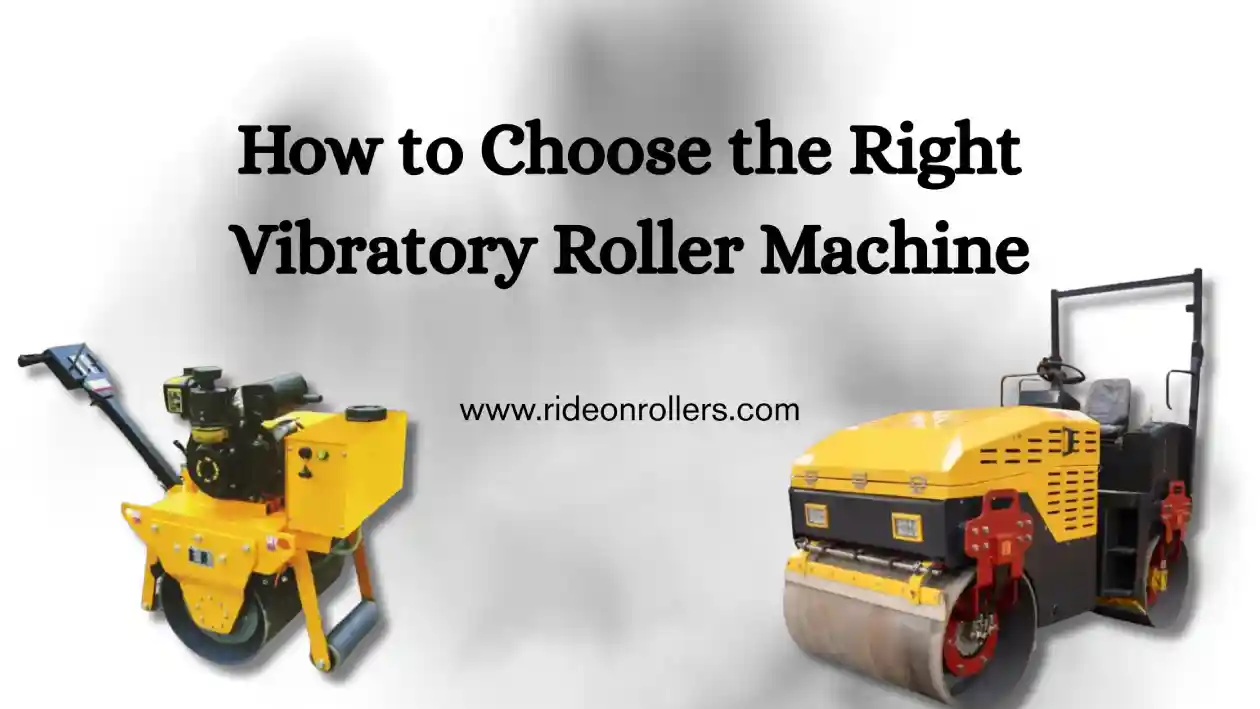
For larger road and infrastructure projects, a ride-on vibratory roller may provide greater coverage and operator productivity. For smaller or restricted areas, a walk-behind roller may be more suitable.
Shree Shakti Infratech offers several roller and compaction-equipment configurations that contractors can compare against their project requirements. The best choice is ultimately the machine that provides the right balance of compaction performance, productivity, maneuverability, reliability, and operating cost.